Research Interests
- Foundations of AI
- LLM Reasoning and Agentic AI
- Causal Inference and Causal Discovery
- Graph Neural Networks
- Multi-Task Learning & Transfer Learning
- Knowledge-guided Learning
- Domain Generalization
- Data Analytics
- Information Reciprocity
- Multi-modal Learning
- Heterogeneous Information Integration
- Use-Inspired AI
- AI for Healthcare
- Computational Social Science
- AI for Science: Hydrology and Macroeconomic Forecasting
- Socially Responsible AI
Current Projects
|
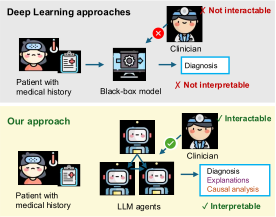
LLM Reasoning, Agentic AI, and Causal Discovery We study how large language models reason and how to make that reasoning faithful and useful in high-stakes settings. This includes knowledge-enhanced agentic causal discovery for interpretable and interactable predictive healthcare [EMNLP 25], intermediate-variable reasoning (EMNLP 26), temporal reasoning over clinical narratives (SDM 26), LLMs for socio-political event interpolation and extrapolation (ECML-PKDD 26), and probing the conceptual hierarchies represented inside LLMs (ACL Findings 26). |
|
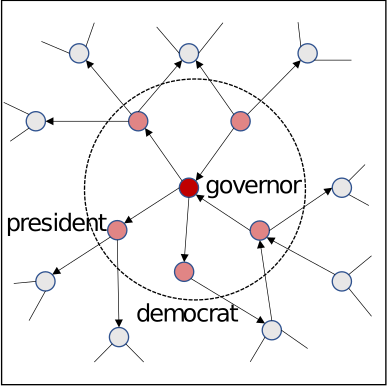
Deep Graph Learning We design new graph neural networks for dynamic and heterogeneous graph data [KDD 19, KDD 20]; We also work on continual graph learning when tasks/data distributions change over time; We focus on novel solutions for knowledge graph reasoning, graph fusion, and temporal graph predictions. We study causality enhanced machine learning to improve interpretability [ICDM 22, KDD 22], continual graph learning [NeurIPS 24], graph out-of-distribution generalization (AISTATS 25), and graph unlearning [KDD 23]. |
|
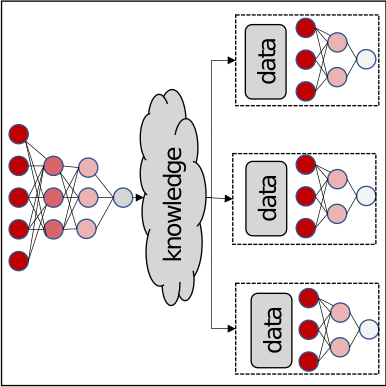
Domain Adaptation, Transfer Learning, and AI for Science We design new transfer learning and multitask learning methods for domain adaptation and bias-mitigation [ICWSM 20]. We also develop multitask learning for imbalanced data and spatiotemporal prediction problems [SDM 18]. We investigate federated learning frameworks for asynchronous settings [BigData 20] and heterogeneous data. We also apply these ideas to science and economics, including cross-reservoir inflow prediction [ICDM-DMESS 25, AAAI-AI4ES 26] and inflation forecasting with dynamic feature spaces (ICDM 25). |
|
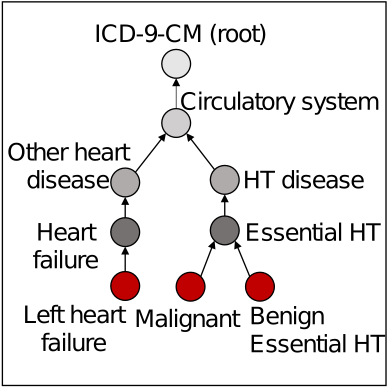
Machine Learning for Healthcare Working with clinical collaborators at Yale School of Medicine, UMass Chan Medical School, and Hackensack Meridian Health, we develop accurate and transparent models for clinical prediction and diagnostic reasoning, including concept-grounded domain adaptation [ICML 26], clinical domain generalization (CIKM 26), lab-informed pretraining for diagnosis [J-BHI 26], and contrastive ICD coding [NeurIPS 23]. Earlier, we utilized health data to develop new machine learning algorithms for personalized care [AAAI 22] and epidemic forecasting [CIKM 20]. We design new domain knowledge guided deep learning models [IJCAI 21] to discover patient-disease relations, hidden disease patterns, and disease topographies. We focus on tasks such as future risk assessment, ICD coding, medical representation learning, and information retrieval. |
|
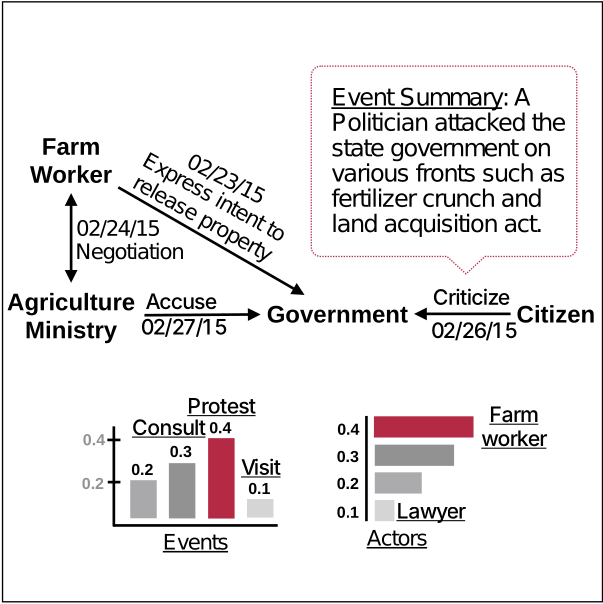
Machine Learning for Social Science We design deep neural networks for societal event predictions including crime, political events, and pandemics. We study new methods for integrating multimodal data [CIKM 21] and causal inference [ICDM 22, KDD 22] in human event analysis. |
|
Socially Responsible AI We are interested in developing efficient and effective detection approaches for socially responsible AI which includes knowledge-based fake news detection [PAKDD 21], fairness in finance [TheWebConf 20], medicine [eBioMedicine], and social networks [ICWSM 22a], and toxic/hate speech detection[ICWSM 20, ICWSM 22b]. |
Tutorials
- Spatio-Temporal Event Forecasting and Precursor Identification at KDD 2019.
- Explainable AI for Societal Event Predictions: Foundations, Methods, and Applications at AAAI 2021.
- Advances in Human Event Modeling: From Graph Neural Networks to Language Models at KDD 2024.
Grants
- NSF CRII: Learning Dynamic Graph-based Precursors for Event Modeling
- NSF CAREER: Towards Deep Interpretable Predictions for Multi-Scope Temporal Events
- NSF EAGER: A Domain-Informed Generative Framework for Joint Learning of Public Medical Knowledge and Individual Health Records
- NSF NAIRR Pilot: compute award supporting research on domain-informed foundation models
- NIH AIM-AHEAD Research Fellowship: AI methods to address and mitigate health outcome disparities
Collaborate With Us
Many of our projects start from a question a clinician or domain scientist brings to us. Current and recent collaborators include Yale School of Medicine, UMass Chan Medical School, Hackensack Meridian Health, U.S. national laboratories, the NJ AI Hub, and colleagues in hydrology, finance, and the social sciences. If you work with clinical records, evolving networks, text, or time series and need predictions you can trust and explain, please email me. Code for many of our papers is available on GitHub.
Sponsors